
CadenceIndependent concept
Care for the days between.
Website
A working page.
Desktop
Phone
Open the working page (new tab)cadence.care (the official site, new tab)
An illustrative concept, not Cadence’s own site or product.
The system
How it scales.
The care interval
Color Tone Continuum
ExplainMonochromatic
58 / 24 / 12 / 6
InviteAnalogous
56 / 26 / 10 / 8
InterruptComplementary
60 / 22 / 12 / 6
ExploreSplit complementary
54 / 22 / 10 / 14
The case studyPDF, 8 pages, 3.5 MB
Earlier work
Care for the days between

Notes, sources and credits
Independent concept by Jason Walker, 2026, not commissioned or endorsed by Cadence. Research checked 27 September 2026.
Strategy, creative direction, copy, design and production: Jason Walker.
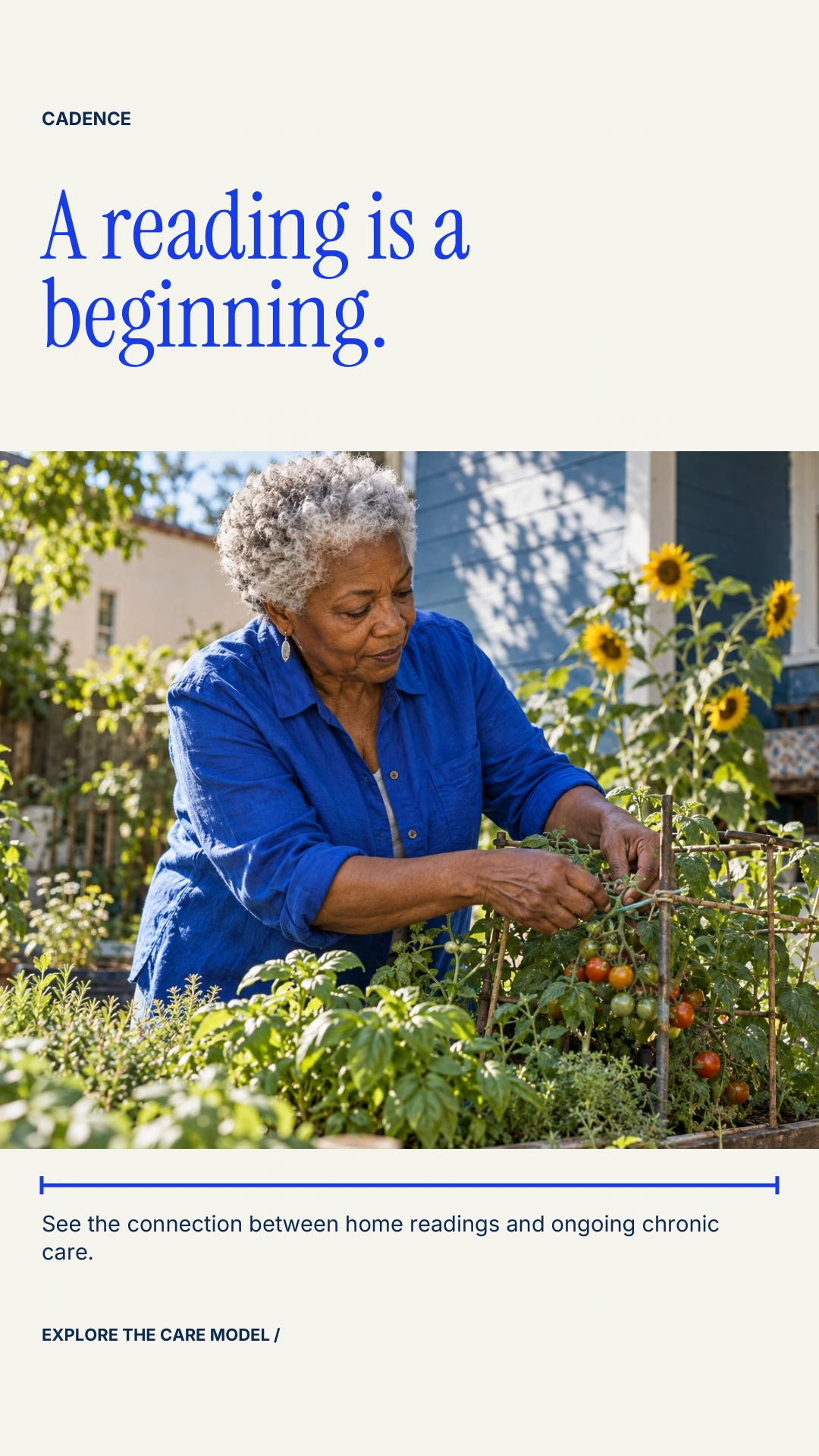
A measured blue interval stretches across candid scenes of ordinary life and becomes the bridge between a person’s day and the clinical support behind it.
What already works. Cadence’s clinical confidence, its evidence, and the link between clinical intelligence and care delivery.
The tension. A patient lives a whole life between appointments. The care model needs to make that interval visible.
The move. Put everyday life at the center of the story and bring the clinical mechanism in as a precise second layer.
Paid social. Test 1: Everyday-life opening versus care-continuity opening. Test 2: Mechanism-led versus people-led explanation. Only the headline changes. The picture, supporting line, offer, audience and placement hold, and no winner is claimed.
Website. An illustrative concept, not Cadence’s own site or product. Its links go to the official pages.
Voice
- Start with life. Name the person’s real day before the system. “A reading at home. A care team paying attention.”
- Explain the mechanism. Make the role of clinical intelligence and the care team legible. “Home readings help the care team see more of the days between.”
- Let evidence carry weight. Put study context and limitations next to every outcome. “Explore the evidence behind the care model.”
- Match the reader. Use reassurance for patients and operational clarity for systems. “Your care team can help you get started.”
The care interval. Two fixed markers connected by one continuous rule. It frames time without pretending to be a medical waveform.
Color. The neutrals sit outside the allocation. The ratios set emphasis; no color is claimed to guarantee a feeling.
The series. The days between: short portraits paired with one approved care-model explanation. Each installment adds the evidence context relevant to its audience.
What I’d measure. Qualified health-system inquiries for acquisition; care-model comprehension for educational content. Patient onboarding is measured separately with the care team. None of this has run, and no results are claimed.
Earlier work. The first-round commercial, 30 seconds, in its original art direction.
The scenes are generated campaign images. The woman pictured is fictional, not a patient, and nothing here is an outcome or a testimonial.
Sources
Production files
Every ad is also composed square and vertical. Square: 1A, 1B, 2A, 2B. Vertical: 1A, 1B, 2A, 2B.







The sending templates beside each email need the sender, postal address, unsubscribe link and hosted image address mapped in the sending platform, and inbox testing before any send.
Type
Instrument Serif and Inter, under the SIL Open Font License (Instrument Serif and Inter).
Paid social
Two headline tests.
Test 1
Test 2