
PlaylabIndependent concept
Built from what you know.
Your teaching. Now a tool.
How it works
From a rubric to a better question.
The educator’s brief
- Learning goal
- Support a claim with evidence.
- Material
- A rubric: claim, evidence, explanation.
- Instruction
- Ask one question before giving feedback.
The learner writes
School should start later because students are tired.
The tool asks
What evidence could help a reader understand how a later start would affect students?
The teacher reviews
Does the question invite evidence without writing the argument for the learner?
The website
Three examples you can run.
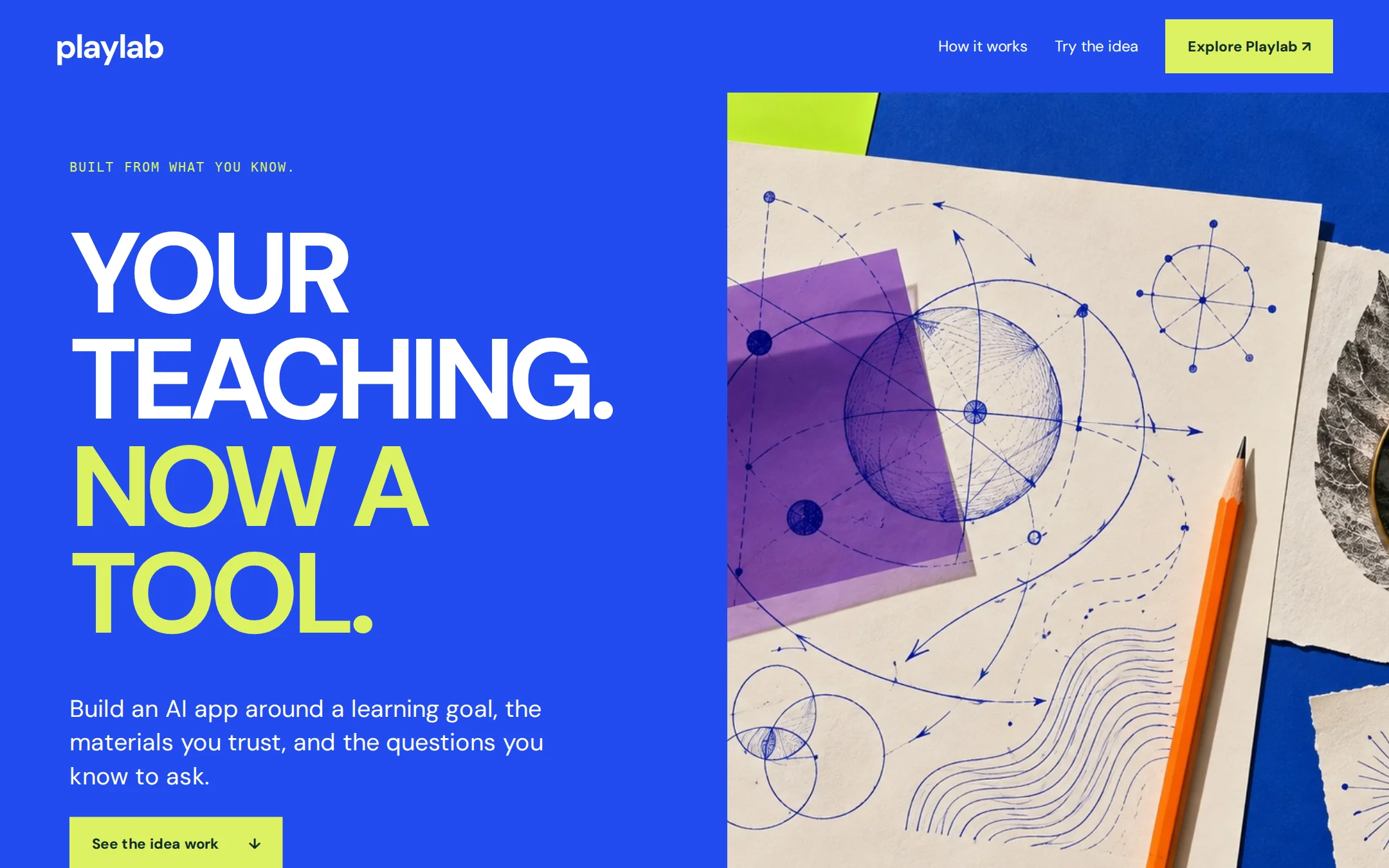
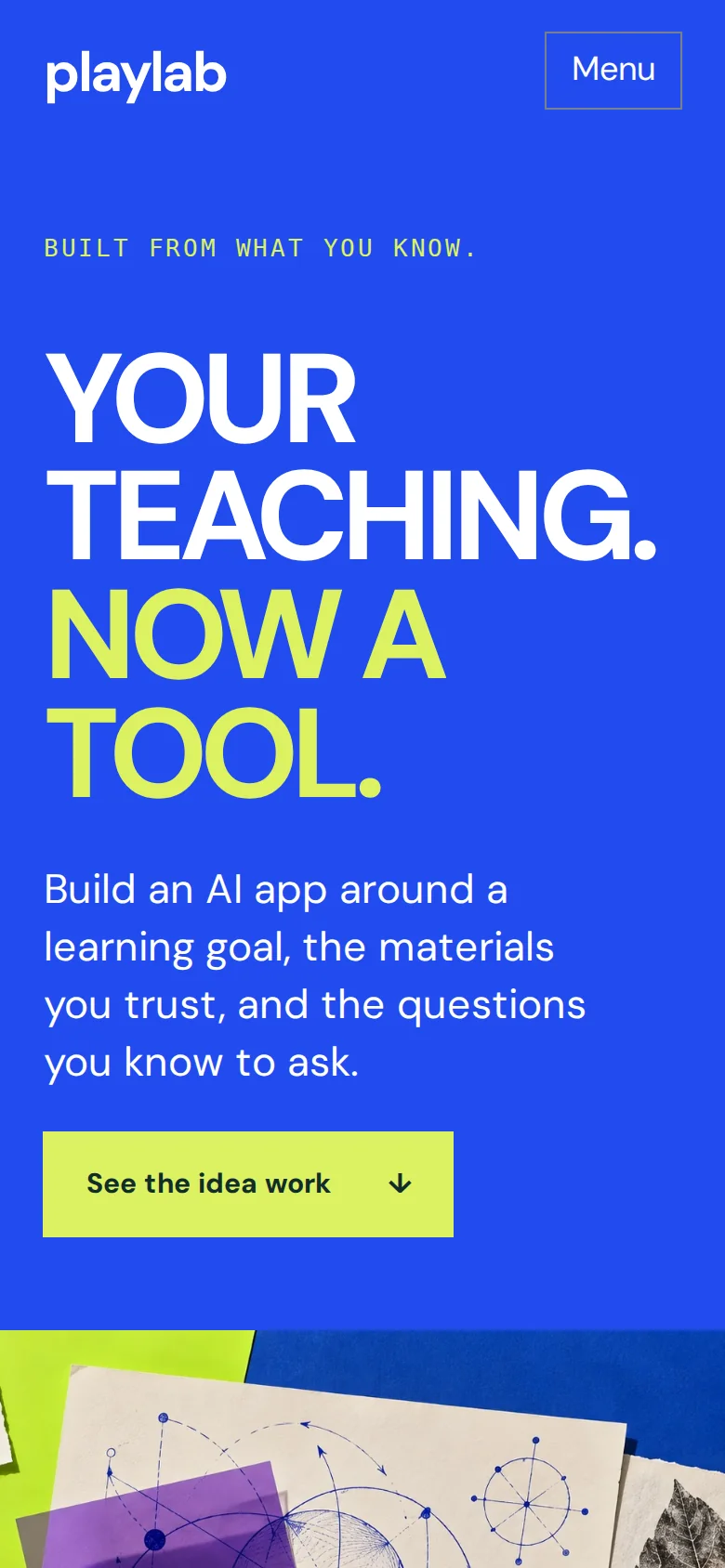
Explore the Website Phone layoutFull window (opens the page on its own, in a new tab)
A concept page, not Playlab’s product.
From the idea to the review.
The system
Every mark points to a question.
Violet acetate
Type
Your teaching. Now a tool.
Choose one thing you want a learner to practice.
01 / The goal
Palette
- Cobalt#214BEE
- Warm paper#F6F3E9
- Forest ink#112D29
- Acid lime#DCF263
- Violet acetate#B89CFF
Color Tone Continuum
A focused chapterMonochromatic cobalt
60 / 25 / 15
Editorial variationAnalogous, cobalt and violet
65 / 25 / 10
An action that needs emphasisComplementary, cobalt and orange
80 / 20
The main campaignSplit complementary, cobalt with yellow-green and a warm accent
65 / 25 / 10
The brand and campaign guidePDF, 8 pages, 2.5 MB
The brand and campaign guide
A system someone can keep building.
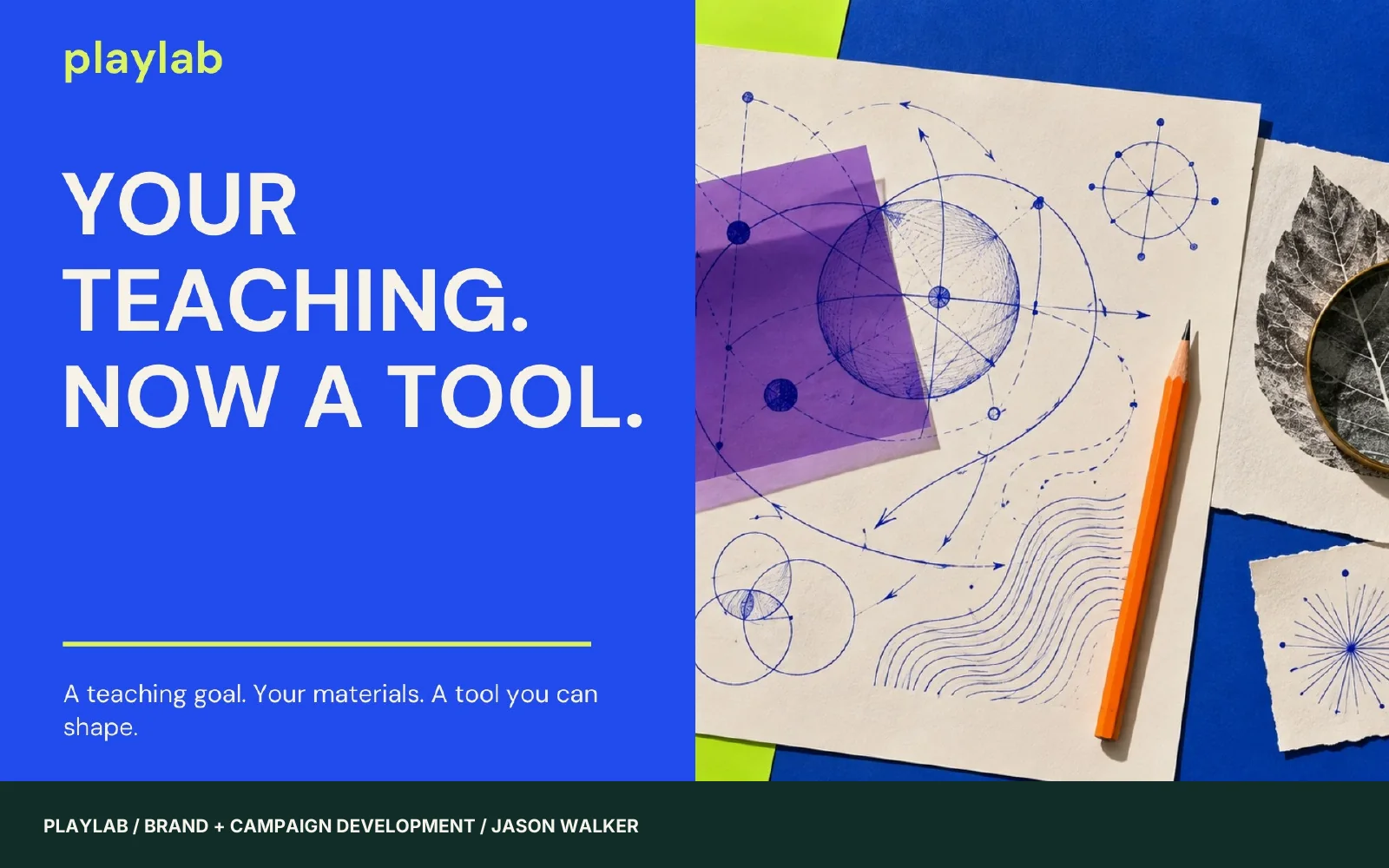
01 Your teaching. Now a tool. 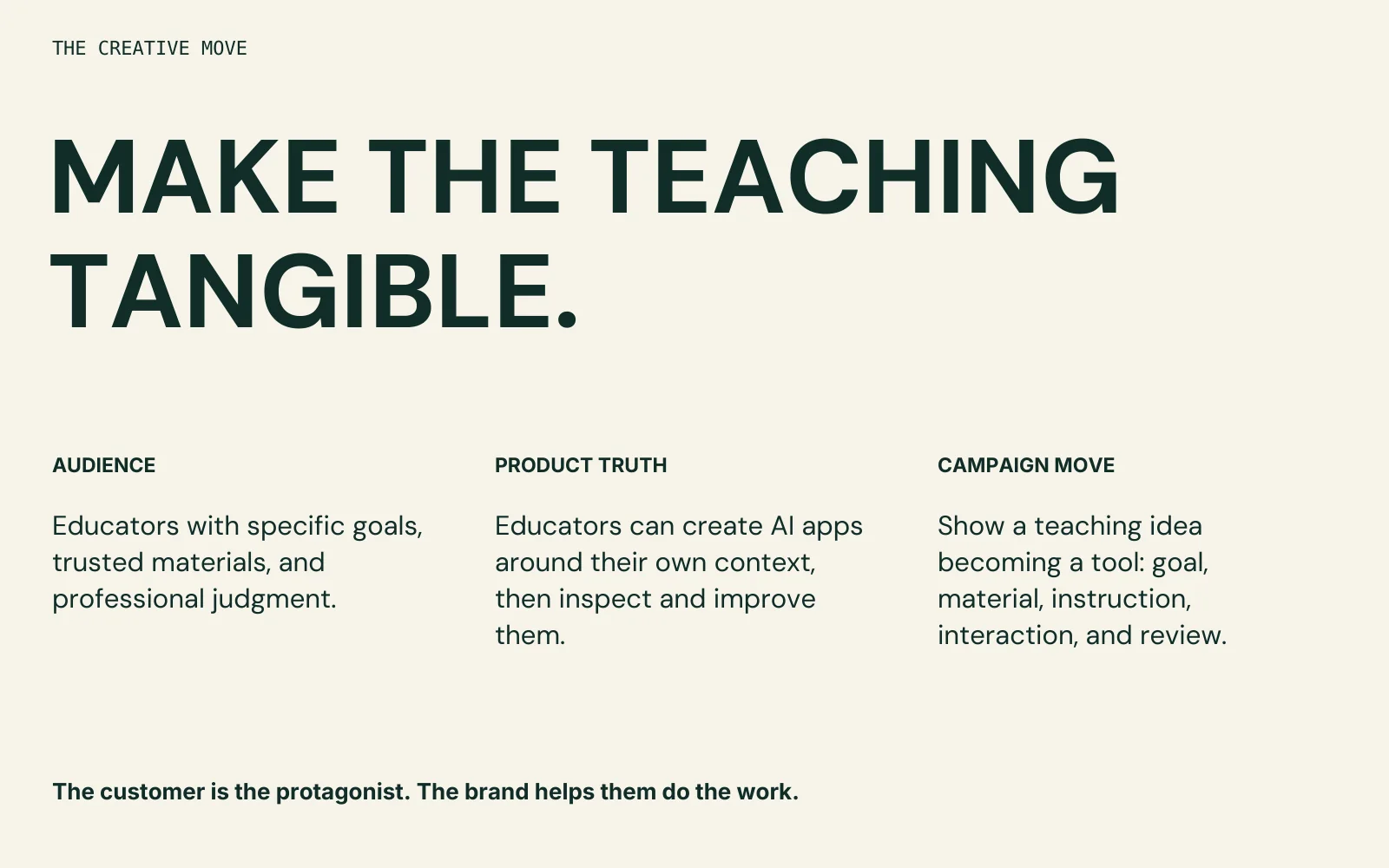
02 Make the teaching tangible. 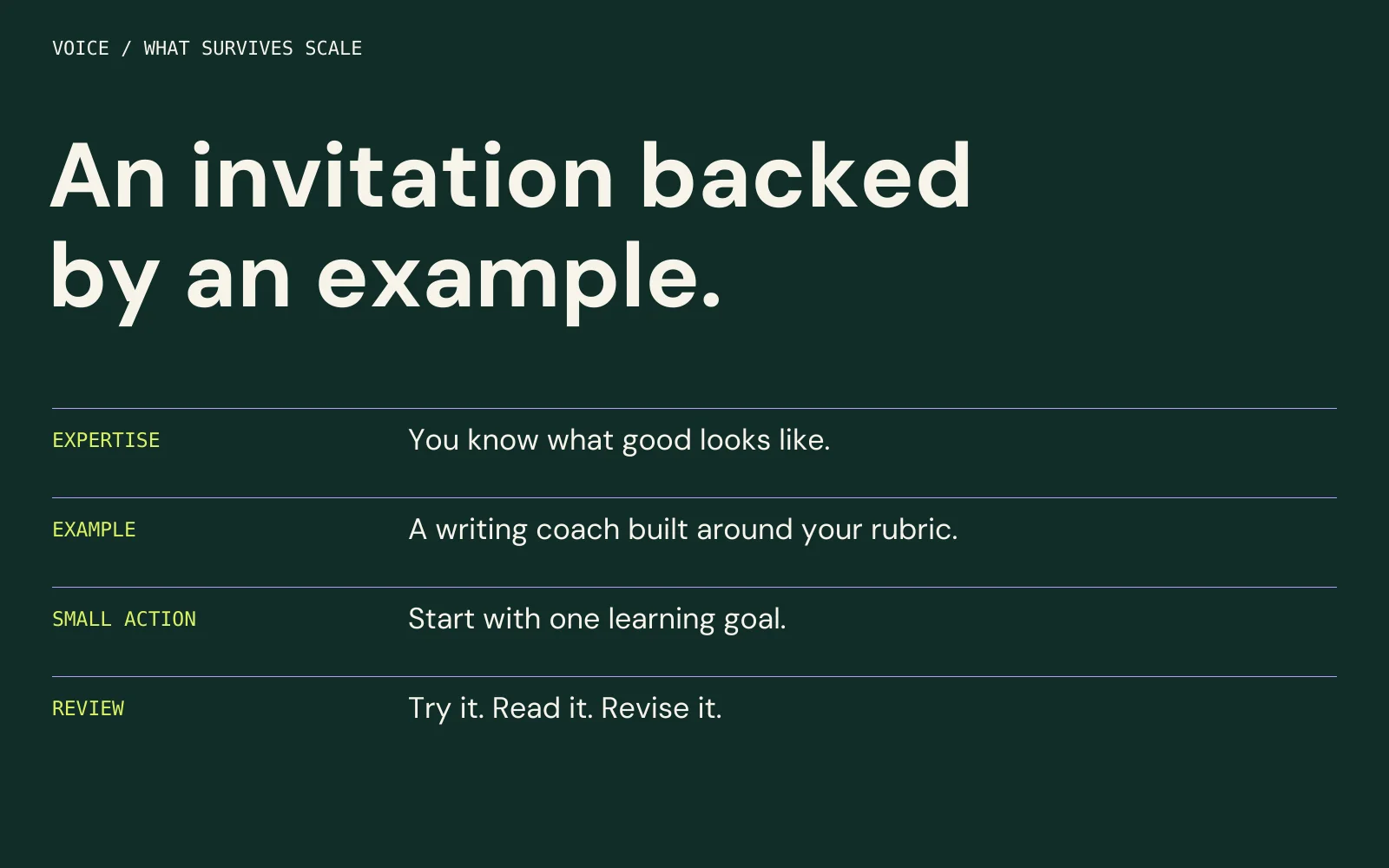
03 An invitation backed by an example. 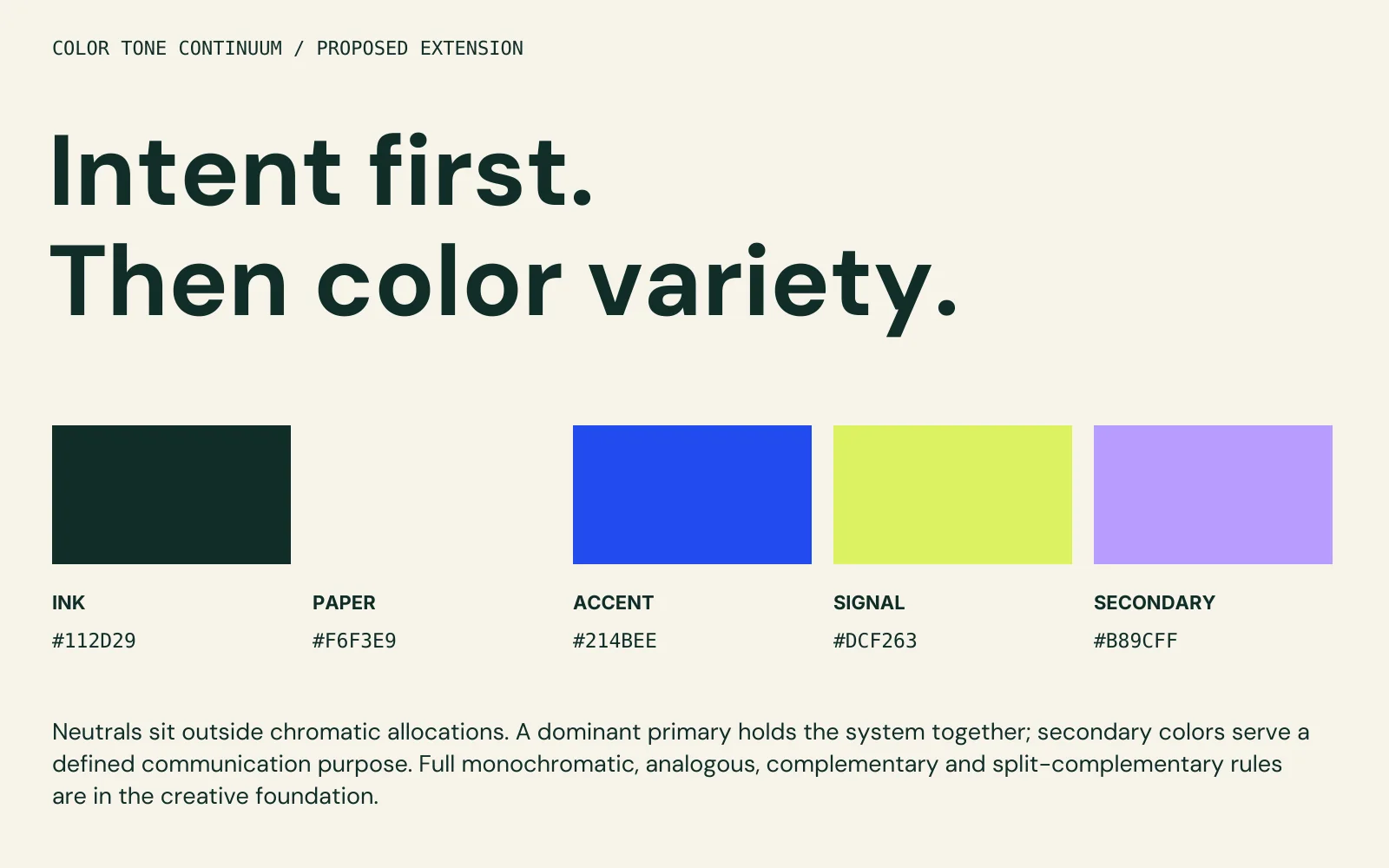
04 Intent first. Then color variety. 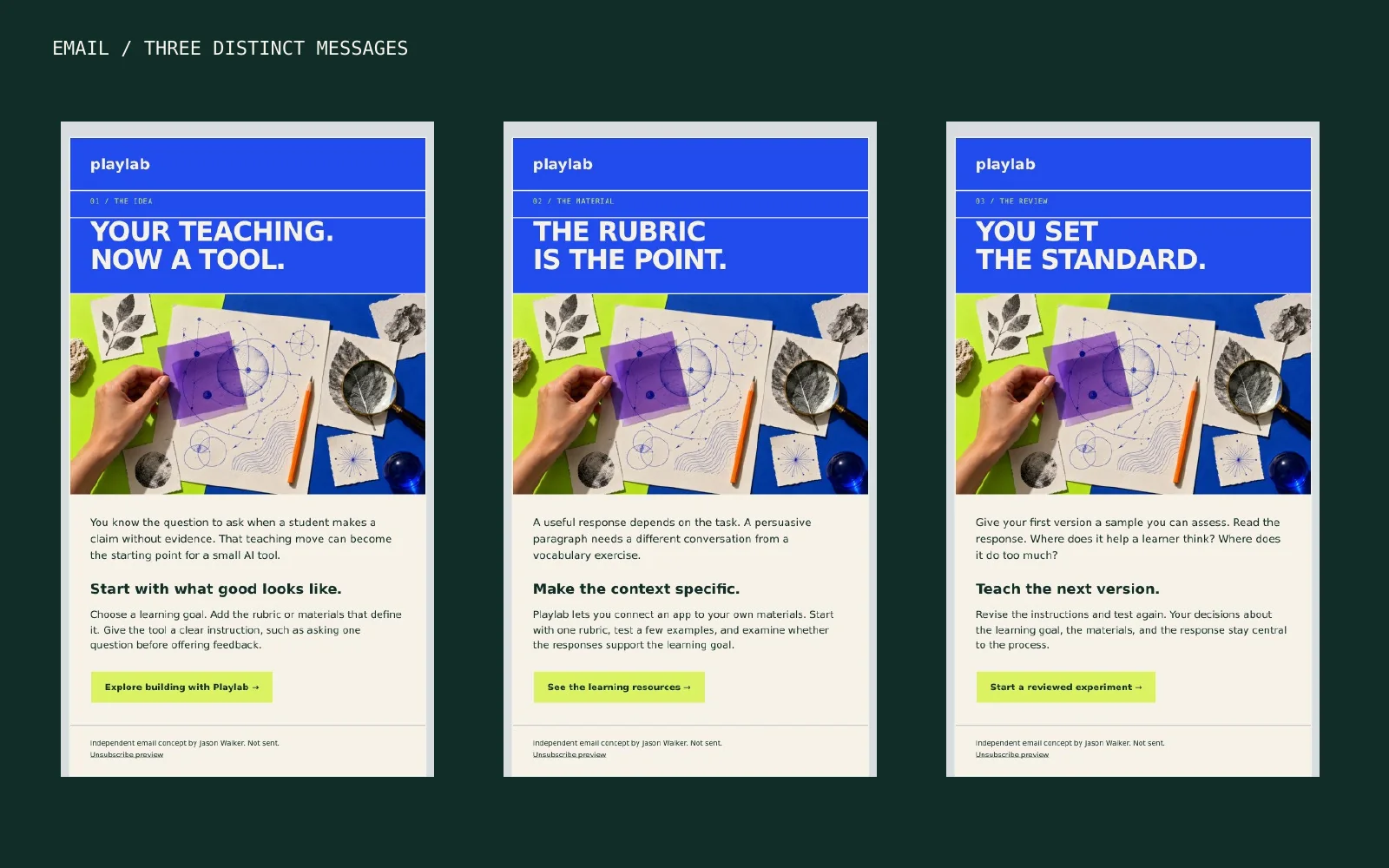
05 Three distinct messages. 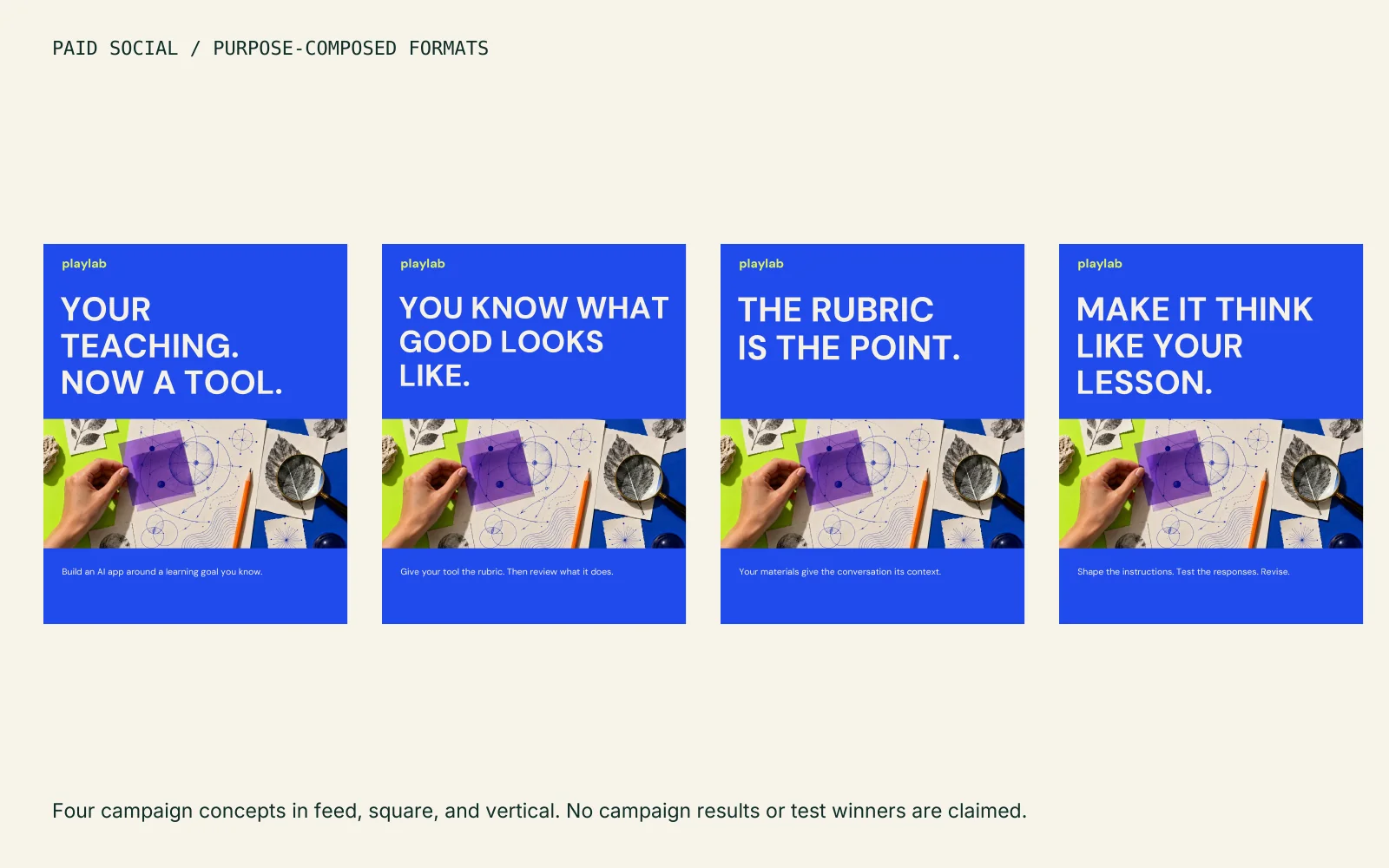
06 Purpose-composed formats. 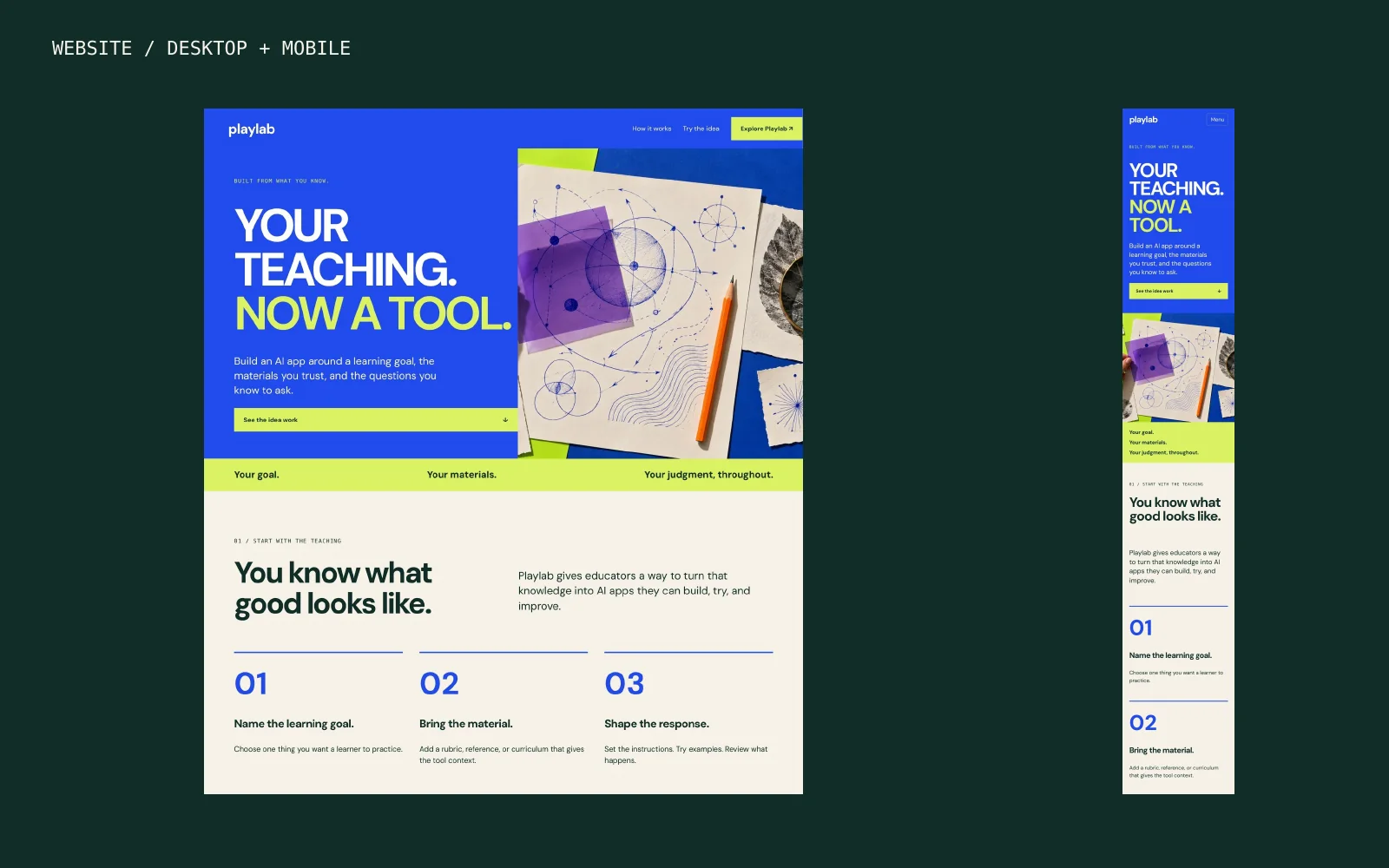
07 The website, desktop and mobile. 
08 A system someone can keep building.
The brand and campaign guidePDF, 8 pages, 2.5 MB
Notes, sources and credits
Strategy, art direction, writing, identity extension and the production system: Jason Walker.
Playlab lets educators build AI apps around their own learning goals, instructions and materials. The campaign says that plainly, then walks one example from rubric to review.
The audience. Educators with specific goals, trusted materials and professional judgment.
The product truth. Educators can build AI apps around their own context, then inspect and improve them.
The move. Show a teaching idea becoming a tool: the goal, the material, the instruction, the learner’s turn and the teacher’s review.
Scripted demonstration. It shows the workflow; it doesn’t call an AI or reproduce Playlab’s interface.
The website. Choose a writing coach, concept practice or a discussion partner. Each lays out the goal, the material and the instruction, then a learner’s sample, a possible response and the question the teacher reviews. A concept page, not Playlab’s product. No AI is called and no student data is used. Its calls to action open Playlab’s official pages.
Email. A teaching idea, the materials that give a tool its context, then the review that keeps the teacher’s judgment in charge. HTML emails with live text and real buttons. None has been sent.
Social. Four campaign executions, not an A/B test: the headline and the supporting line change together. A fair test would hold the picture, audience, placement and call to action, and change only the headline.
Voice
- Begin with expertise. Treat educators as people with valuable judgment. “You know the question to ask.”
- Explain with a teaching example. Show the task before describing AI. “Help a learner support a claim with evidence.”
- Offer a manageable action. Keep the first experiment small. “Start with one rubric.”
- Preserve review. Make the teacher’s evaluation visible. “Try it. Read it. Revise it.”
- Be specific about capability. Separate instructions from model training. “Shape the instructions around your lesson.”
Violet acetate. Hard paper edges, visible material and purposeful marks. A sheet of violet acetate or a lime rule always lands on a question, a selection or a revision, never on decoration.
Color. Proposed extension colors, not Playlab’s official standards. Cobalt holds the field; lime invites; violet is a material cue. Neutrals sit outside the allocations. The ratios are composition rules, not measured effects.
What I made
- Brand analysis and strategy
- Art direction and the tactile identity extension
- The campaign writing
- The working page and its three scripted examples
- The production system: composition code, templates and PDF masters
The authorship image was generated with AI inside that system.
What stays Playlab’s. The name and the product belong to Playlab, and the capabilities described come from its public materials. The campaign, its language and every execution on this page are new.
What it would measure. Can a reader explain what Playlab lets an educator do, and name a useful first experiment? Then qualified starts, first reviewed tools and feedback on the learning process. Nothing has run, and no results are claimed.
Independent concept by Jason Walker, 2026, not commissioned or endorsed by Playlab. Sources checked 27 September 2026.
The authorship scene is generated and fictional. The three examples are prewritten: no AI is called, no student data is involved, and nothing here is Playlab’s interface.
Sources
Type
DM Sans under the SIL Open Font License (DM Sans); DejaVu Sans Mono under its own free licence (licence).
Paid social
Four invitations to build.